
1 Kings 19:9a, 11–13a; Psalm 85; Romans 9:1–5; Matthew 14:22–33
Walking Through Life’s Challenges
Dear friends, today is the 19th Sunday in Ordinary Time. The readings invite us to reflect on two important themes. First, the Gentle Breeze – we see how God manifested himself to the prophet Elijah—not through the earthquake, the strong wind, or the fire, but through a gentle breeze. Second, the Power of God – in the Gospel, Jesus walks on the turbulent sea and invites Peter to do the same. When Peter begins to sink, Jesus reaches out to save him.
Our Christian catechesis teaches us that God is all-powerful, but he is also gentle and compassionate toward his people. The Old Testament contains many accounts of God’s power, whether defending his people or correcting them because of their unfaithfulness. In Genesis, for example, the world is purified through the flood, while Sodom and Gomorrah are destroyed by fire because of their grave wickedness. In Exodus, God demonstrates his power by delivering the Israelites from slavery in Egypt.
Yet, whenever God reveals himself to his prophets, he often encounters them in moments of silence, calmness, and serenity. This is what we see in today’s first reading with the prophet Elijah. God is peaceful and gentle, and he often meets us in the stillness of our hearts. To recognize God’s presence, we need a serene heart and a quiet spirit.
God certainly has the power to intervene in our lives, but his power is not intended to frighten or destroy us. Rather, God uses his power to save, defend, guide, and teach his people. Whenever God manifests his might, it is ultimately for the good of his people.
However, many people today have been made to believe that God’s intervention must always be accompanied by spectacular demonstrations of power, loud prayers, dramatic miracles, or extraordinary manifestations.
While it is right for us to turn to God with our problems and needs, we need to be careful about a distorted understanding of God’s power. Some modern-day preachers and self-proclaimed prophets can give the impression that miracles must always be spectacular and theatrical. Unfortunately, sometimes these demonstrations seem to draw more attention to the person performing the miracle than to God himself.
In today’s first reading, we encounter the prophet Elijah fleeing from Jezebel, the wife of King Ahab, who wanted to kill him after the contest on Mount Carmel. Elijah retreats into a cave and, overwhelmed by his situation, even asks God to take his life.
The Lord then tells Elijah to go out and stand on the mountain because he is about to pass by. Elijah waits for God’s manifestation. First comes a great and powerful wind that tears apart the mountains and breaks the rocks. Elijah expects God to be present in the wind, but God is not there. Then comes an earthquake, but God is not in the earthquake. After the earthquake comes a fire, but God is not in the fire.
Finally, there comes the sound of a gentle breeze. When Elijah hears it, he covers his face, recognizing that God is present.
This is a powerful lesson for us. God is a gentle Father. He is not a violent force that human beings can manipulate or a power that can be used to impress others. God reveals his power according to his own wisdom and purpose.
The New Testament gives us another important perspective. In the ministry of Jesus, violent and destructive manifestations are often associated with evil spirits, while the Holy Spirit is presented as the Spirit of peace, consolation, truth, and life. In John 3:8, Jesus compares the Spirit to the wind: “The wind blows where it chooses, and you hear the sound of it, but you do not know where it comes from or where it goes.”
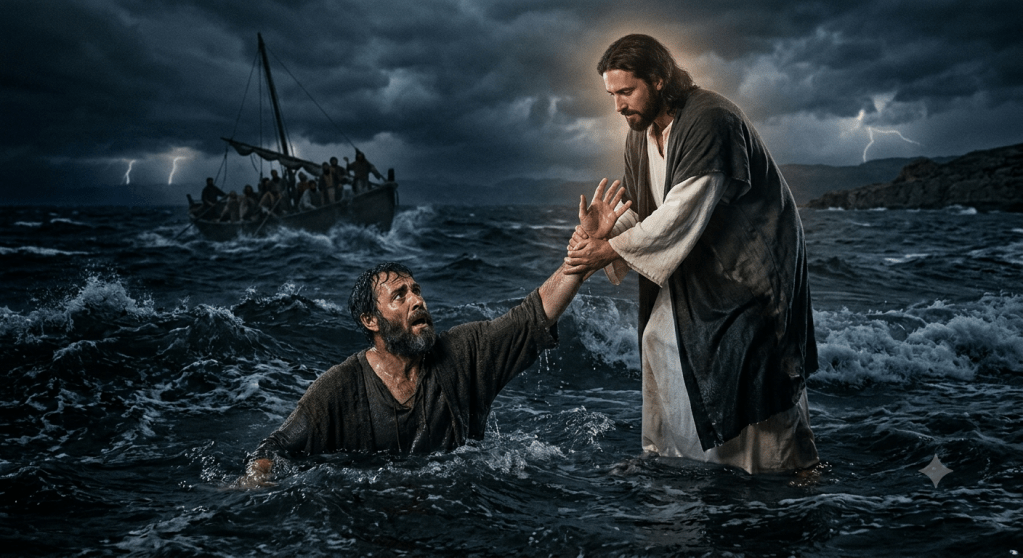
In today’s Gospel, the disciples are caught in a storm while crossing the sea. In the biblical world, the sea was often associated with chaos and forces beyond human control. In the middle of the storm, the disciples see Jesus walking on the water. Because of their fear, they do not immediately recognize him. They think they are seeing a ghost. Jesus reassures them: “Take courage! It is I. Do not be afraid.”
Peter then says, asks Jesus if he could go to him. At first he was able to walk on the turbulent waters, but when he notices the strong wind, he becomes afraid. He takes his eyes off Jesus and begins to sink. This is a powerful image of our Christian journey.
The boat can represent our life, family, vocation, work, business, relationships, or community. Sometimes the boat is rocked by storms: financial difficulties, family conflicts, failures, disappointments, sickness, criticism, rejection, or uncertainty about the future. The important question is not whether storms will come. They will. The important question is who is in our boat when the storm comes.
Peter’s problem was not that he stepped out of the boat. His problem was that he took his eyes off Jesus. As long as we remain focused on Christ, we will be able to walk on the turbulent waters of our life. But when we concentrate on the storms around us, fear takes control and we begin to sink. Today’s Gospel reminds us: Do not take your eyes off Christ.
Dear friends, let us learn to recognize God not only in the extraordinary but also in the ordinary. Let us create moments of silence and prayer so that we can hear his gentle voice. And when the storms of life come, let us remember Peter’s experience. Keep your eyes on Jesus. With Christ as our focus, we may still encounter difficulties, but we will not face them alone. The storms may be strong, but God’s grace is stronger.
May the Lord give us the faith to walk through life’s challenges, the wisdom to recognize his gentle presence, and the courage to keep our eyes fixed on Christ.
Have a blessed Sunday.
Fr. Lawrence Muthee, SVD

