
Revelation 7:2–4, 9–14; Psalm 24 (23); 1 John 3:1–3; Matthew 5:1–12
Called to Sainthood
Dear friends, today is the 31st Sunday in Ordinary Time. Since it is also 1 November, the Church celebrates the Solemnity of All Saints, which takes precedence over a Sunday in Ordinary Time.
Sainthood is a state of holiness and righteousness attained through the grace of God and our cooperation with it. Saints are those who have completed their earthly journey, been redeemed by the blood of the Lamb, fought the good fight, kept the faith, and received the crown of eternal life (2 Tim 4:7–8).
The Church recognizes and canonizes those faithful who have demonstrated heroic virtue and holiness in their lives. Yet sainthood is a universal vocation. We are all called to holiness, a journey that begins with God’s grace in Baptism and continues through our efforts to remain faithful servants until the end.
In the early Church, saints were often recognized through public veneration. In the 10th century, Pope John XV formalized the process of canonization. Although the Church formally recognizes many saints, countless others have attained heaven without being officially declared saints. Our ancestors and loved ones may also be among them. Those who have been canonized serve as models of Christian life because they imitated Christ and remained faithful to him.
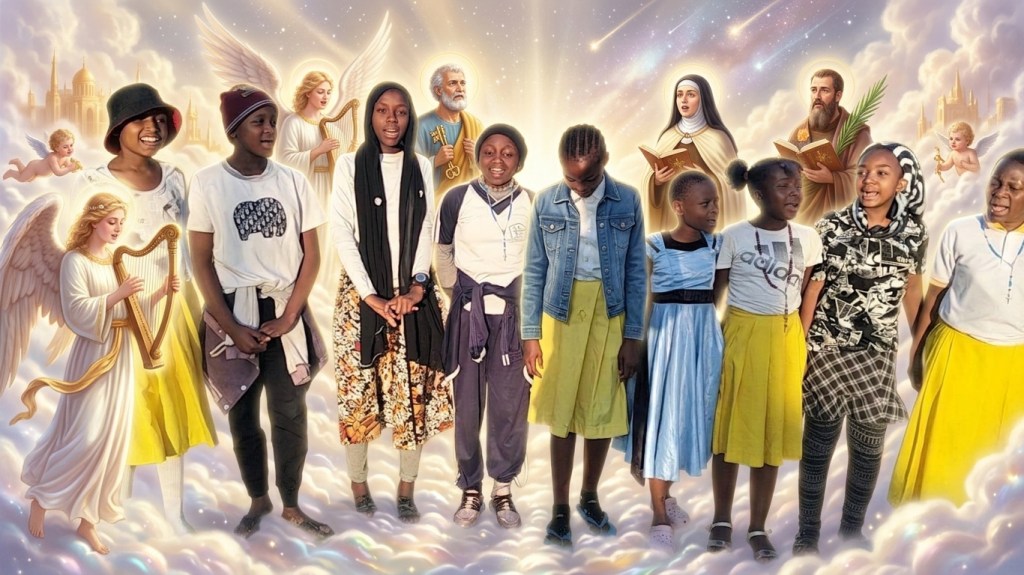
Today’s first reading from the book of Revelation presents a heavenly vision in which saints from every nation, tribe, people, and language worship God together with the angels. Sainthood is therefore a universal invitation, open to people of every race and background.
In the second reading, St John reminds us that we are children of God through Christ and that one day we shall see God as he truly is. This hope inspires us to purify our lives and remain faithful to him.
In the Gospel, Jesus presents the Beatitudes as the path to holiness. Being poor in spirit, gentle, mourning, hungering and thirsting for righteousness, showing mercy, making peace, and enduring persecution for the sake of righteousness are virtues that often contradict the world’s values. Yet this is the way to sainthood.
St Augustine reminds us that God, who created us without our cooperation, will not save us without it. God respects our freedom and does not impose salvation on us. We must freely choose to live lives worthy of heaven.
Jesus also showed us that the cross is part of the journey to sainthood. Once a cruel instrument of execution, the cross became a symbol of salvation. Jesus was falsely accused of serious crimes, including political rebellion, but his true offence in the eyes of his opponents was challenging the darkness of ignorance and exposing injustice. His message threatened those who benefited from the suffering and oppression of the lowly.
His crucifixion was the culmination of his earthly ministry, during which he prepared his disciples to continue his mission. Today, all the baptized are called to fight the battle between good and evil. The evil one continues to mislead people and draw them away from God.
As we have reflected before, we are born with the capacity to learn, and our environment greatly influences whether we embrace good or evil. Parents have the primary responsibility to instil good values in their children from an early age. The community, school, Church, and other social institutions build upon what is first established at home.
The moral challenges we face today reveal a serious neglect of value formation. Many parents struggle to find time to shape their children’s character, while economic pressures consume family life. Some institutions have become more concerned with profit than their mission. Consequently, we spend considerable time and resources addressing the symptoms of social problems while neglecting their roots.
Since arriving in my new parish as pastor barely three months ago, I have received more than fifteen marriage cases. Listening to these couples has made me realize how much the reverence for marriage and its vows has declined. Many people no longer feel bound by their promises; instead, they prioritize personal interests over their commitments.
This is a dangerous path for the family, the community, and society. When people disregard shared values and legitimate authority, disorder follows. Subjectivism takes over, and everyone pursues personal interests regardless of moral principles or the common good.
Such attitudes make leadership increasingly difficult. Guiding people who disregard established principles and responsibilities becomes a serious challenge. Social media, with its constant stream of unfiltered information, can make matters worse. In a recent article, I discussed the effects of digitalization and artificial intelligence on human behaviour: svdkentan.com: Effects of Digitalization and AI on Human Behaviour.
Dear friends, becoming saints in today’s world may require extraordinary perseverance. The lives of the saints remind us that holiness demands courage, sacrifice, and fidelity to God. Let us ask our Lord for the grace to interpret the signs of the times wisely and remain firmly on the path to eternal life.
Have a blessed Feast!
Fr. Lawrence Muthee, SVD

