
Deuteronomy 8:2–3, 14–16; Psalm 147; 1 Corinthians 10:16–17; John 6:51–58
The Meaning of the Eucharist
Dear friends, today we celebrate in a special way what we experience every day: the real presence of Christ in our midst through the Sacrament of the Eucharist. This feast is celebrated on Thursday after Pentecost, but because of its significance, many dioceses celebrate it on Sunday.
Before His suffering and death, Jesus celebrated the Jewish Passover with His disciples. The Passover commemorated the day when the angel of the Lord struck the Egyptians but “passed over” the houses of the Israelites, which had been marked with the blood of the lamb. This event ultimately compelled Pharaoh to let the Israelites go free. Jesus transformed this ancient feast into something entirely new and offered His disciples—and all of us—the greatest gift the world has ever known: His own Body and Blood as food for our souls that redeems us from slavery to the world.
In the celebration of the Holy Mass, we relive the sacrifice that Jesus offered to God the Father for our redemption. On the Cross, Jesus replaced the unblemished Passover lamb with Himself. He also replaced the high priests who offered sacrifices on behalf of the people. Christ became at once the altar, the priest, and the sacrificial lamb offered for the salvation of the world. As Christians, we are called to imitate Christ by offering ourselves in loving sacrifice for the good of others.
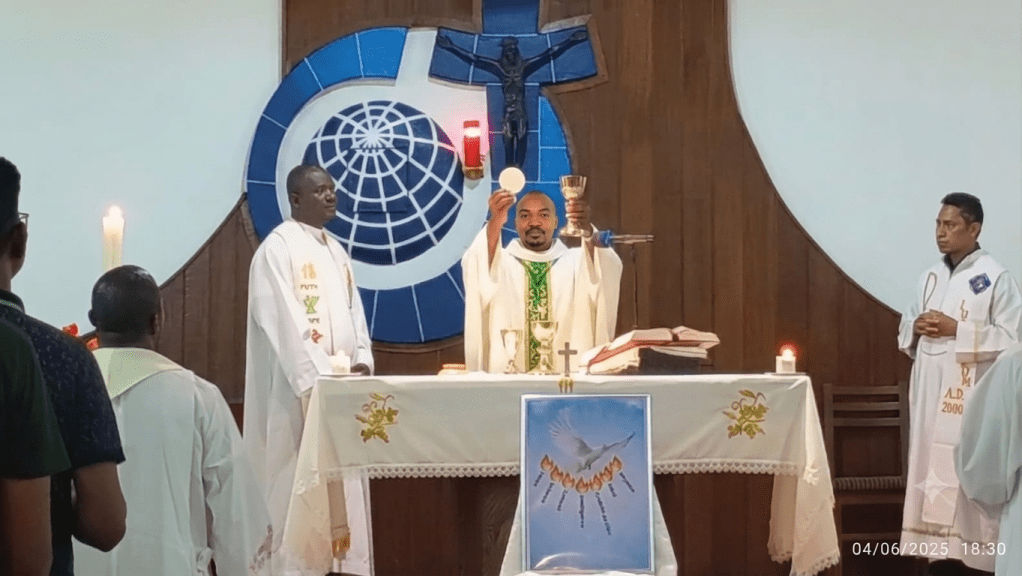
The priest is ordained and anointed to share in the priesthood of Christ so that he may offer to God the same sacrifice that Jesus offered for the faithful. Through the grace of the Sacrament of Holy Orders, the priest acts in persona Christi—that is, in the person of Christ. He represents Christ, who offers the sacrifice and makes the Eucharist present for the faithful in the celebration of the Holy Mass. One may not always appreciate the personality of an individual priest, but a good Christian will always recognize and respect Christ’s presence and action through the priest. Through the ministry of the Church, the priest becomes a visible sign of Christ among His people.
The Eucharist is the summit and culmination of the seven sacraments that Christ entrusted to His Church for our salvation. But what exactly are the sacraments, and especially the Eucharist?
St. Augustine defines the sacraments as “visible signs of invisible grace, instituted by Christ to give or increase grace in us.” They are visible signs because Christ chose tangible realities that we can see and experience to communicate the invisible and eternal realities that can only be perceived through faith.
In Baptism, water is the visible sign of God’s cleansing grace, which removes original sin and all personal sins. As a sign, the effectiveness of Baptism does not depend on the quantity of water used. In the Eucharist, the visible signs are bread and wine, which, through the prayer of consecration by the priest, become truly the Body and Blood of Christ.
The Eucharist is food for our souls on their journey back to God. In the first reading, Moses reminds the Israelites how God sustained them during their journey through the desert by providing manna from heaven and water from the rock. Just as our bodies need nourishment to remain strong and healthy, our souls need the Eucharist to remain spiritually strong and alive until the day we return to God. This great gift is made possible through the faith handed down to us by the Apostles through the Church.
In the Gospel, Jesus declares: “I am the living bread.” When we receive the Eucharist, we receive Christ Himself into our lives. Therefore, the natural consequence should be the imitation of Christ in both word and deed. We become living tabernacles that carry Christ into the world, and others should encounter Him through us.
If this does not happen, then we may not have fully understood the meaning of the Eucharist, and we risk rendering the Eucharistic presence of Christ within us inactive. The grace of the Eucharist is not fully expressed through adoration of the Blessed Sacrament alone, important as that is, but also through living in a truly Eucharistic manner. To act as Jesus would act in every situation is to become a Eucharistic person. In the second reading, St. Paul reminds us that because we share in the one bread, we must also be one body. This challenges each of us to ask: Am I truly Eucharistic?
A proper understanding of the Eucharist also requires proper preparation. We devote significant time and attention to preparing for birthdays, graduations, weddings, and even political rallies. We carefully attend to every detail. Yet when it comes to the most important celebration in our lives as Christians—the Eucharist—we often do little or no preparation at all.
The Eucharist is the gift of Christ’s real presence, given to us at the cost of His life. In the Gospel, Jesus teaches that He is the living bread that gives life to those who partake of Him. If we truly understood what the Eucharist is and what it can do for us, we would not willingly miss it, even for a single day.
Many people begin their day with activities such as yoga, jogging, or meditation to strengthen their bodies and minds. While these practices have their value, many forget that a strong body and a sharp mind are not enough. If the soul is weak from lack of spiritual nourishment, the entire day can lose its proper direction. We may need to re-examine our daily priorities and adjust them accordingly.
Dear friends, let us continue to deepen our understanding of the Eucharist so that we may fully benefit from the grace it offers us and become instruments of that grace for others.
Have a blessed feast.
Fr. Lawrence Muthee, SVD
 SVD JAMBO KENTAN