
Matthew 21:1–11; Isaiah 50:4–7; Psalm 21(22); Philippians 2:6–11; Matthew 26:14–27:66
Sacrificing for a Greater Cause
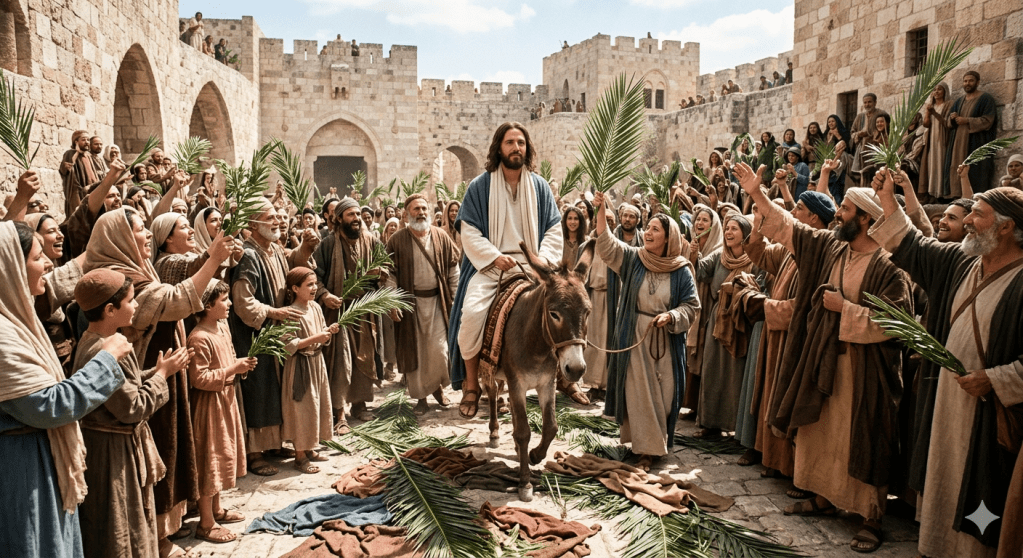
Dear friends, today we enter into the solemn threshold of Holy Week with Palm Sunday—the day Jesus makes His public and deliberate entry into Jerusalem as King. For weeks prior, He had withdrawn from public attention because His life was under threat: “They picked up stones to throw at Him, but Jesus hid Himself” (John 8:59); “The Pharisees went out and plotted to kill Him… so He withdrew” (Matthew 12:15–16). Yet today, He steps forward—not in fear, but in courage. He who once hid now reveals Himself openly, fully aware of what lies ahead.
This movement from hiddenness to revelation is not accidental; it is deeply symbolic. The Church echoes this mystery by veiling crucifixes and sacred images during these final days of Lent. The veiling signifies Christ’s hidden presence as He enters His Passion. The cross—our sign of victory—and the images of the saints—witnesses of that victory—are temporarily concealed so that our focus may rest entirely on the suffering through which salvation is accomplished. When Christ dies, the veil of the Temple is torn in two, revealing the deeper meaning of His sacrifice: access to God is no longer restricted. The Kingdom is now open to all.
The triumph we celebrate today is therefore paradoxical. Jesus enters Jerusalem not to overthrow political powers, but to surrender Himself. Earthly kings wage war and shed the blood of others to secure freedom; Christ sheds His own blood to grant eternal freedom. Others ride warhorses, symbols of dominance and strength; Jesus chooses a donkey—humble, burdened, and often overlooked. His kingship is defined not by force, but by self-giving.
The first reading from Isaiah presents the image of the Suffering Servant—silent, obedient, and resolute even in the face of brutality. He offers no resistance. His dignity lies precisely in this surrender. Saint Paul deepens this vision: though Christ was in the form of God, He did not cling to His divine status. Instead, He emptied Himself, accepting humiliation, suffering, and death—for a greater purpose – the salvation of the world.
This is the heart of Christian discipleship. To follow Christ is to accept that fidelity often entails suffering. Opposition, misunderstanding, and even hostility are not exceptions; they are part of the path. The temptation is always to retaliate, to defend oneself aggressively, or to assert power. Yet Christ proposes a different logic: non-violence, patience, and trust in God’s justice.
In practical life—within families, workplaces, and communities—this teaching is demanding. It requires restraint when provoked, humility when misunderstood, and perseverance when unjustly treated. Those entrusted with leadership in the Church carry an even greater responsibility to embody this non-violent witness. Experience in ministry often confirms how strong the impulse can be to resist or assert authority when challenged. Yet the example of Christ clarifies the path: violence perpetuates violence; resistance often intensifies opposition. True strength lies in disciplined self-giving.
The Passion narrative also presents two contrasting groups, both of which remain present in our world today.
The first group includes Judas, who betrays for personal gain; Peter, who falters under pressure; and the crowd, easily manipulated into injustice. It includes leaders who abandon truth for power, and systems that exploit ignorance to maintain control. These figures represent the recurring human tendencies toward self-interest, fear, and moral compromise.
The second group offers a different witness. Simon of Cyrene helps carry the cross—an image of shared burden. Veronica shows compassion in a moment of brutality. Mary, the mother of Jesus, and Mary Magdalene remain faithful to the end, standing firm in love and understanding. Joseph of Arimathea uses his position to ensure dignity in death. These individuals embody courage, solidarity, and fidelity to what is right.
The essential question, then, is direct and unavoidable: in which group do you stand?
Holy Week is not merely a commemoration of past events. It is an invitation to enter personally into the mystery of Christ’s Passion, Death, and Resurrection. These are not distant realities; they form the foundation of Christian identity and hope. To live this week attentively is to allow these events to reshape our faith, renew our commitment, and deepen our understanding of what it means to follow Christ.
Let this sacred time not pass as routine. Engage it deliberately. Reflect, pray, and participate. In doing so, the week and failing aspects of your faith and Christian witness will be rekindled with clarity and conviction.
Have a blessed and fruitful Holy Week.
Fr. Lawrence Muthee, SVD
 SVD JAMBO KENTAN