
Ezekiel 37:12–14; Psalm 129 (130); Romans 8:8–11; John 11:1–45
You Shall Live Again
Dear friends, we are approaching the climax of the Lenten Season. Next Sunday ushers us into Palm Sunday and the solemn beginning of Holy Week—the culmination of Christ’s journey to the Cross and the revelation of the Resurrection. In this context, the Word of God offers us a compelling promise: “You shall live again.”
Life is God’s most fundamental gift. Every living being carries within it a deep instinct for survival and preservation. Even when life becomes burdensome and heavy, the natural inclination of the human heart is still to live. This desire reflects something profound: we are created not for death, but for life.
Our faith affirms that God is the author and sustainer of life. The life we receive from Him does not terminate in the grave; rather, it is transformed. Yet Scripture often uses the language of “death” not only in the physical sense but also as a spiritual and existential condition.
In the first reading, the people of Israel in exile are described as dry bones—lifeless, scattered, and without hope. They had lost everything that defined them: their land, their king, and the Temple—the very sign of God’s presence among them. It is into this state of desolation that God speaks His promise: “I will put my spirit within you, and you shall live.” This is not merely restoration; it is re-creation.
This raises a direct question: are there areas in your life where you feel like dry bones—drained of hope, strength, or meaning?
Our contemporary context mirrors this reality. We encounter forms of “death” all around us: fractured relationships, broken families, loss of faith, systemic corruption, deep poverty, and the erosion of moral values. These are not merely social problems; they are signs of a deeper spiritual exhaustion. We often romanticize the past—speaking of better days—yet remain reluctant to take responsibility for renewal in the present.
Saint Paul, in the second reading, sharpens this diagnosis. He teaches that sin is fundamentally opposed to the life of the Spirit. Sin suffocates divine life within us; it leads to interior decay. Where the Spirit is absent, life diminishes.
Consider a simple image. Decay produces a stench that attracts flies. These flies, though seemingly harmless, carry contamination and spread disease. In contrast, what is vibrant and life-giving—like flowers—attracts bees. Bees gather nectar and, through their work, produce honey—something both nourishing and healing. The question is not trivial: what does your life attract? What do others encounter in you—decay or vitality? Sin disfigures; grace restores.
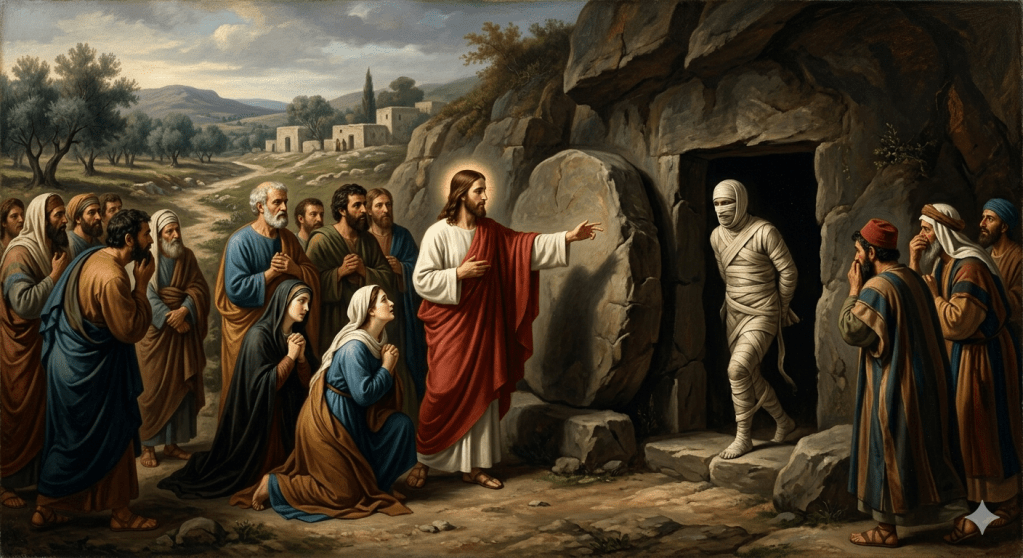
The Gospel presents the raising of Lazarus, one of the most profound signs in John’s Gospel. It is not only a miracle; it is a revelation. Jesus deliberately delays responding to the news of Lazarus’ illness. This delay is not indifference—it is purposeful. As with the man born blind in last Sunday’s Gospel, the situation becomes an occasion for the manifestation of God’s glory.
When Jesus arrives, the situation is humanly irreversible. Lazarus is dead and buried. Martha expresses a faith that is doctrinal—she believes in the resurrection on the last day. Mary expresses a faith that is emotional—marked by grief and disappointment. Both are real, yet incomplete.
Jesus responds not with explanation, but with action. He weeps—revealing both His humanity and His compassion. Yet He also commands: “Lazarus, come out.” And the dead man emerges.
This moment discloses a decisive truth: no situation is beyond the reach of God’s life-giving power. What appears final to us is not final to Him.
Faith, therefore, is not static. It is a journey—often marked by uncertainty, delay, and struggle. There are moments when God seems absent, when hope appears extinguished. Yet the presence of Christ transforms even the darkest terrain. If He is with us, then despair is never the last word.
As we approach Holy Week, the Church invites us to contemplate the depth of God’s love—a love that enters into death in order to conquer it. This contemplation must not remain abstract. It calls for concrete expression in charity.
We are urged to be attentive to those who are “lifeless” in our communities—the discouraged, the forgotten, the wounded. Material assistance is necessary, but insufficient. What restores life is not only what we give, but how we give it. True charity communicates dignity, hope, and presence. It participates in God’s own act of restoring life.
“You shall live again” is not only a promise for the future; it is an invitation for the present. It calls us to allow the Spirit of God to breathe anew into every area of dryness within us—and through us, into the world.
Have a fruitful Lent.
Fr. Lawrence Muthee, SVD
 SVD JAMBO KENTAN