

Sunday readings in brief 19 A
1 Kings 19:9a.11-13a; Psalms 85, Romans 9:1-5; Mathew 14:22-33
Walking upon challenges
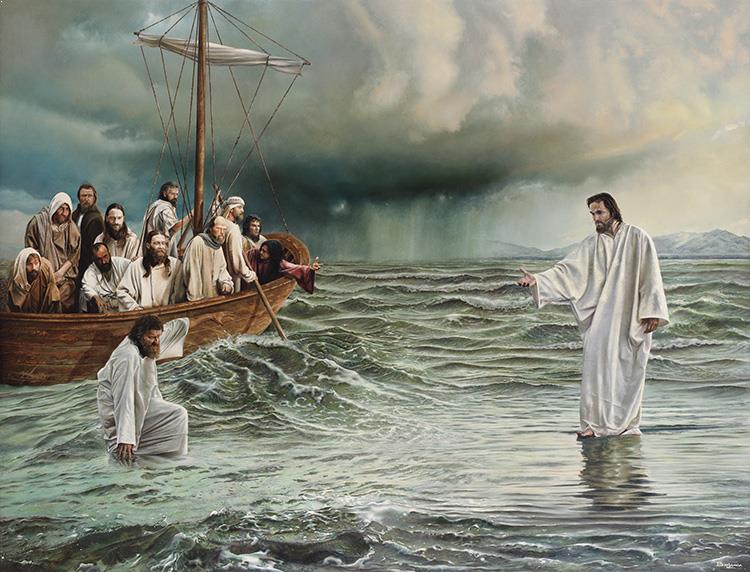
Dear friends, today is the 19th Sunday in ordinary time. There are at least two themes to reflect on from the readings today. First, is how God manifested himself to Elijah in a gentle breeze as opposed to an earthquake, strong wind, and fire. The second is similar, Jesus walks on the turbulent sea and even invites Peter to do the same. Later he calms the sea and those in the boat proclaim him the son of God.
In our catechesis, we are taught that God is all-powerful but also gentle with his people. In the Old Testament, there are numerous manifestations of God’s might and power either when fighting for his people or scolding them for their unfaithfulness. In the book of Genesis, God destroys the perverse inhabitant of the world by flood and the immoral city of Sodom and Gomorra by fire. However, in the book of Exodus, God saves the people of Israel from Egypt through a demonstration of power and might against the Egyptians.
Whenever God wanted to speak to his prophets, he always chose calmness and serenity as we have read from the episode of Prophet Elijah on the mountain today. God is peaceful and gentle, and he always meets us in the calmness of our spirit. God is in us and to discover his presence we require serenity of heart and spirit. He has the power not to instill fear or destroy but to defend his people. Whenever God manifests his might it is either to defend or teach something to his people. However, many worshippers have been made to believe that God’s intervention in our lives can only be through demonstration of might and in loud utterances.
While it is the right thing to turn to God for solutions to our problems, the concept of God that is preferred by many sole proprietor prophets and preachers is what calls my attention. Many people have been made to believe that miracles must always be accompanied by spectacular demonstrations of might and power sometimes even theatrical. The problem I see in this kind of worship is that these demonstrations of might are not meant to give glory to God but rather to make popular the one dispensing these miracles in the name of God. If we think for a moment, we will realize that the biggest and the most significant miracles of our lives are surrounded by serenity. Take for example the miracle of life itself, we go about our daily lives without even noticing that we are breathing. When people die, we say they are now peaceful.
In the first reading, we encounter the episode where Elijah runs away from Jezebel the wife of king Ahab who wanted to kill him after the contest of Mt. Carmel. Elijah hides in a cave praying that God would take his life (he had ordered the death of 450 prophets of Baal). The lord commanded him to go out of the cave so that he can meet him. Elijah waited for God to manifest himself. First, there came ‘a great strong wind’ that tore apart the mountains and crushed the rocks and Elijah thought that God was in it, but he was not in the strong wind. Then there came the earthquake and fire but the Lord was not in any of them. Finally, there came a whisper of a gentle breeze, and Elijah covered his face not to see the Lord because the Lord was in the gentle wind.
God is a gentle father and not a violent force or a powerful spirit that can be used by men to perform miracles. The literal interpretation of the Old Testament and strategical selection of Bible verses by the merchants of miracles have made the vulnerable believe that God’s help can only be manifest in loud prayers, theatrical miracles, and in out-of-this-world scenes.
In the New Testament, and especially in the ministry of Jesus, it is the evil spirit that is depicted as violent and that caused a disturbance on the people possessed and not the Holy Spirit. The Holy Spirit is calm and comforting. In John 3:8, Jesus tells Nicodemus that ‘you hear the voice of the Spirit but you do not know where he comes from or where he goes’ just like the wind. After his resurrection and ascension, Jesus sent the Holy Spirit to direct and guide his Church in worship and bring God’s graces upon his people.
In the Gospel reading, the storm is not associated with the Holy Spirit but with the evil spirits that were believed to live in the sea. When the disciples saw someone walking on the sea amid a storm, they did not think it was Jesus but rather an apparition of an evil spirit. Jesus came to save them from the storm and once he was aboard the boat, there was a calm on the sea.
Peter, like other disciples, was very afraid because the storm was threatening to sink the boat. When Jesus spoke to them and said he was the one, Peter immediately wanted to abandon the rocking boat and save his life abandoning his colleagues. However, he began to sink when he removed his gaze on Jesus and looked at the storm around. We too begin to sink in life’s troubles when we remove our gaze from Christ and focus on the storm around us. When we abandon the Church because of personal challenges, problems at home, at the workplace, and in our businesses, we sink. Let us not lose our focus on Christ and we will calm all the storms in our life no matter how big they are. With Jesus as our focus, we will be able to walk on all the obstacles put in our way by the evil one and his agents.
Dear friends, today I would like to invite us to only focus on our call to follow Christ and not be destructed by many storms that surround us. The moment we begin to focus on negative critics, paying attention to gossip about us, or lazy company, we begin to sink. We can go on learning and correcting our faults but always on the march focused on Christ.
Have a blessed Sunday
Fr. Lawrence Muthee, SVD
 SVD JAMBO KENTAN